One of the oldest ways of classifying governments comes from the ancient Greeks, especially Aristotle and Plato. Their basic question was simple:
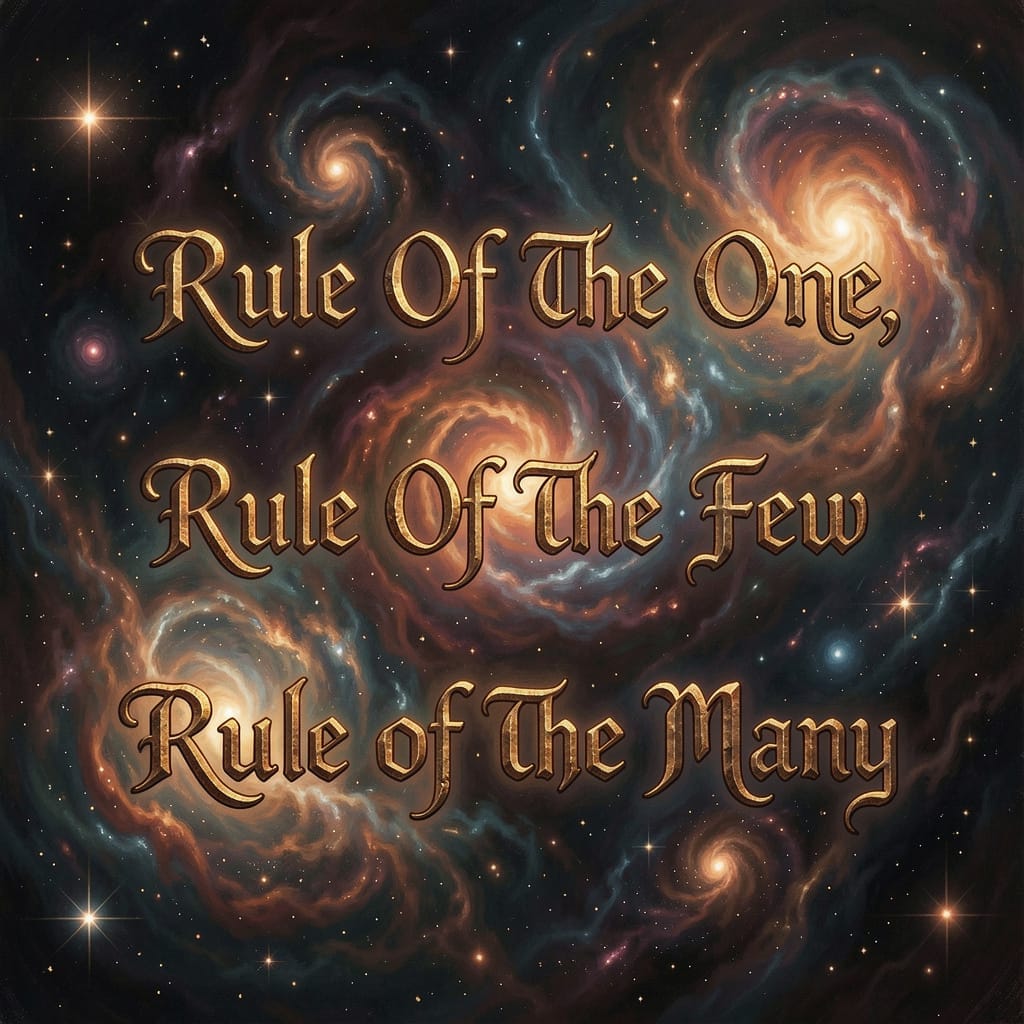
- Who rules?
- One person?
- A few people?
- Many people?
This is often called the numerical classification of government. Nearly every political label answers one or both of two questions:
- How many rule?
- Who are they, or what gives them authority?
These two dimensions are often confused. For example, a monarchy is defined primarily by who rules (a monarch), while a democracy is defined primarily by how political power is distributed among the people.
The Three Fundamental Categories
| Number of Rulers | Greek Root | Basic Idea |
|---|---|---|
| Rule of One | Monos | One individual governs |
| Rule of Few | Oligoi | A small minority governs |
| Rule of Many | Demos/Polis | Large numbers of citizens govern |
Everything else is largely a variation on these themes.
RULE OF ONE
Government where ultimate authority rests in a single individual.
| System | Meaning | Why it fits |
|---|---|---|
| Monarchy | Rule by a king or queen | One hereditary ruler |
| Autocracy | Rule by one person with unrestricted authority | One ruler regardless of title |
| Dictatorship | One individual exercises near-total power | One ruler through force or political control |
| Absolute Monarchy | Monarch possesses nearly unlimited power | Pure rule of one |
| Caesarism | Rule centered around one charismatic leader | Personal authority dominates |
| Despotism | Absolute, often arbitrary rule | One ruler |
| Tyranny | One ruler governing oppressively | Aristotle’s corrupt form of monarchy |
| Bonapartism | Strong centralized rule by one leader backed by military/popular support | One ruler |
Variations of Rule of One
Sometimes the ruler derives authority from a particular source.
| System | Source of Authority |
|---|---|
| Divine Monarchy | God |
| Constitutional Monarchy | Constitution limits monarch |
| Military Dictatorship | Armed forces |
| Revolutionary Dictatorship | Revolution |
| Presidential Autocracy | Elections that evolve into personal rule |
RULE OF FEW
Power is concentrated in a relatively small group.
| System | Meaning | Why it fits |
|---|---|---|
| Oligarchy | Rule by a small elite | Classic rule of few |
| Aristocracy | Rule by the “best” or noble class | Small privileged elite |
| Plutocracy | Rule by the wealthy | Rich minority |
| Technocracy | Rule by technical experts | Small group of specialists |
| Meritocracy | Rule by the most capable | Elite selected by achievement |
| Theocracy | Rule by religious leaders | Clerical elite |
| Timocracy | Rule by property owners or honored citizens | Limited qualified class |
| Gerontocracy | Rule by elders | Small older elite |
| Stratocracy | Rule by military leaders | Officer corps governs |
| Noocracy | Rule by the wise or knowledgeable | Intellectual elite |
| Particracy | Political parties dominate | Party leadership governs |
| Bureaucracy | Career officials exercise effective power | Administrative elite |
| Corporatocracy | Large corporations dominate politics | Economic elite |
| Judiciocracy (Juristocracy) | Courts dominate political decisions | Judicial elite |

Aristotle’s View
Aristotle believed oligarchy and aristocracy were different.
- Aristocracy = rule by the genuinely virtuous and capable.
- Oligarchy = rule by the rich for their own benefit.
Modern political science often uses “oligarchy” much more broadly.
RULE OF MANY
Political authority ultimately comes from a broad population.
| System | Meaning | Why it fits |
|---|---|---|
| Democracy | Citizens participate in government | Rule of many |
| Republic | Public affairs governed through representatives and law | Usually many through representation |
| Representative Democracy | Citizens elect representatives | Indirect rule of many |
| Direct Democracy | Citizens vote directly | Purest rule of many |
| Liberal Democracy | Democracy plus constitutional rights | Many with legal protections |
| Participatory Democracy | High citizen involvement | Many actively govern |
| Deliberative Democracy | Decisions through public discussion | Many participate |
| Consensus Democracy | Broad agreement sought | Many share power |
Systems That Don’t Fit Perfectly
Some describe how government operates rather than how many rule.
| System | Explanation |
|---|---|
| Federalism | Power divided geographically |
| Confederation | Sovereign states cooperate |
| Unitary State | Central government dominates |
| Constitutionalism | Government limited by law |
| Rule of Law | Law above rulers |
| Parliamentary System | Executive drawn from legislature |
| Presidential System | Separate executive |
| Semi-presidential System | Hybrid executive |
These are structural arrangements rather than answers to “who rules?”
Systems That Describe Corruption
These describe the quality of rule rather than the number of rulers.
| System | Meaning |
|---|---|
| Kleptocracy | Government by thieves |
| Kakistocracy | Government by the worst or least qualified |
| Cronyism | Rule favoring friends |
| Nepotism | Rule favoring relatives |
| Patrimonialism | State treated as personal property |
| Corruption | Abuse of public office |
A kleptocracy could be ruled by one dictator or by many officials.
Mixed Categories
Many governments combine multiple ideas.
For example:
United Kingdom
- Monarchy (one king)
- Parliamentary democracy (many)
- Constitutional government
- Representative government
Iran
- Republic
- Democracy (elections)
- Theocracy (clerical oversight)
- Oligarchy (Guardian Council limits candidates)
People’s Republic of China
- One-party state
- Technocratic elements
- Party oligarchy
- Increasingly personalized leadership
No single label captures the whole system.
Aristotle’s Famous Classification
Aristotle divided governments according to who rules and whether they govern for the common good or private interest.
| Number | Good Form | Corrupt Form |
|---|---|---|
| One | Monarchy | Tyranny |
| Few | Aristocracy | Oligarchy |
| Many | Polity (Constitutional Government) | Democracy* |
*Aristotle used “democracy” differently from today. He saw it as rule by the poor majority in its own interest. Modern usage generally treats democracy as a positive or neutral term.
A Different Way to Organize Them
Another useful taxonomy is by the basis of legitimacy:
| Basis of Rule | Examples |
|---|---|
| Heredity | Monarchy |
| Wealth | Plutocracy |
| Birth/Nobility | Aristocracy |
| Religion | Theocracy |
| Military | Stratocracy |
| Expertise | Technocracy |
| Intelligence/Wisdom | Noocracy |
| Achievement | Meritocracy |
| Age | Gerontocracy |
| Popular Consent | Democracy |
| Property | Timocracy |
| Party | Particracy |
| Bureaucratic Office | Bureaucracy |
Where Does Anarchy Fit?
Anarchy is fundamentally different because it rejects the premise that there is a sovereign ruler.
The Greek anarkhia literally means “without a ruler.”
Different schools of anarchism propose different ways to organize society—through voluntary association, mutual aid, markets, communes, or federations—but they generally reject centralized political authority. In the simple “one, few, many” framework, anarchy sits outside the classification because it is rule by none, or more precisely, the absence of a governing sovereign.
The Broad Pattern
                 GOVERNMENT

                   WHO RULES?

          One        Few          Many
          │          │             │
          │          │             │
      Monarchy    Oligarchy    Democracy
      Autocracy   Aristocracy  Republic
      Tyranny     Plutocracy   Direct Democracy
      Dictatorship Technocracy Representative Democracy
                  Meritocracy  Participatory Democracy
                  Theocracy
                  Gerontocracy
                  Stratocracy
                  Noocracy
                  Timocracy

Outside the framework:
Anarchy → No sovereign ruler

Quality of rule (can apply to any category):
Kleptocracy • Kakistocracy • Cronyism • Nepotism
This “rule of one, few, or many” framework remains one of the most durable ways to classify governments. Most modern political terms either identify how many people ultimately hold power or specify which group holds that power (wealthy, clergy, military, experts, party leaders, or the general public). In practice, however, most real-world governments are hybrids that combine several of these characteristics rather than fitting neatly into a single category.